
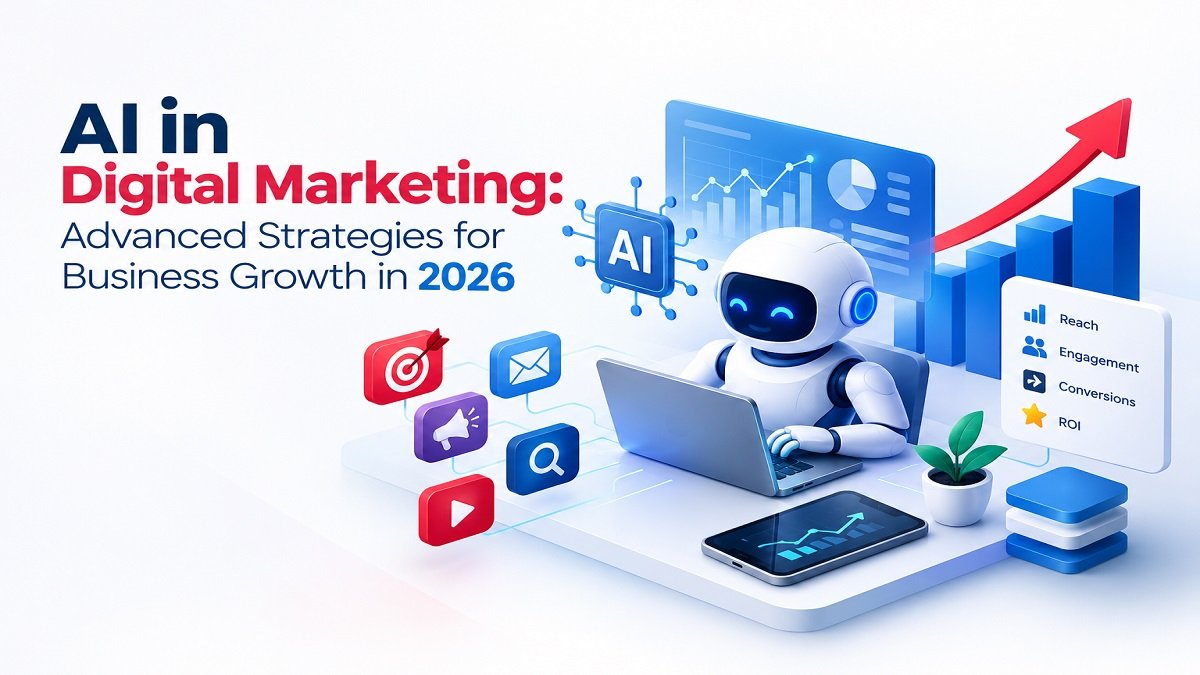
Digital Marketing AI is transforming how businesses attract customers, improve search engine rankings, and increase conversions. By using artificial intelligence, marketers can analyze customer behavior, automate repetitive tasks, personalize campaigns, and make data-driven decisions. As a result, businesses can improve marketing efficiency and deliver better customer experiences.
In 2026, artificial intelligence is becoming an important part of modern marketing strategies. From content creation to search engine optimization (SEO), AI-powered tools help marketers discover opportunities and make informed decisions. This guide explores the benefits, applications, and best practices of Digital Marketing AI for businesses of all sizes.
What Is Digital Marketing AI?
Digital Marketing AI refers to the use of artificial intelligence technologies to plan, manage, analyze, and improve digital marketing activities. These technologies can process large amounts of data, identify patterns, and provide insights that support marketing decisions.
For example, marketers can use AI tools for keyword research, audience segmentation, email automation, content planning, and advertising optimization. Moreover, machine learning can help businesses understand customer preferences and predict potential buying behavior.
However, AI should support human expertise rather than replace it completely. Human creativity, strategic thinking, and fact-checking remain essential for successful marketing.
Key Benefits of Digital Marketing AI
Businesses can benefit from artificial intelligence in several ways. When implemented strategically, Digital Marketing AI can help improve productivity and marketing performance.
- Improved personalization: Deliver relevant content and offers based on customer interests.
- Time savings: Automate repetitive marketing tasks and reporting.
- Better targeting: Identify audiences who are more likely to engage or convert.
- Data-driven decisions: Analyze customer behavior and campaign performance.
- Campaign optimization: Discover opportunities to improve advertising results.
- Scalable marketing: Manage more campaigns and customer interactions efficiently.
Furthermore, businesses can use these insights to allocate resources more effectively. Nevertheless, results depend on data quality, the tools selected, and how well the strategy is implemented.
How Digital Marketing AI Improves Content Marketing
Content marketing is one of the most practical applications of artificial intelligence. AI-powered tools can help marketers research topics, generate outlines, identify content gaps, and organize editorial calendars.
For instance, a marketer can use AI to discover frequently asked questions, brainstorm blog topics, and structure an article before writing. In addition, AI tools can assist with proofreading and readability improvements.
Best Practices for AI Content Creation
To create useful and trustworthy content, follow these practices:
- Research your audience and understand their search intent.
- Use AI to brainstorm ideas and prepare content outlines.
- Verify facts, statistics, and external references.
- Add original insights, examples, and practical experience.
- Edit the content to ensure accuracy and a natural writing style.
- Review the final article before publishing.
Importantly, AI-generated content should provide genuine value to readers. Avoid publishing large amounts of unedited content simply to target more keywords.
Digital Marketing AI for SEO Optimization
Search engine optimization helps businesses attract relevant visitors from search engines. Digital Marketing AI can support SEO by helping marketers research keywords, analyze search intent, identify content gaps, and review website performance.
Moreover, AI tools can suggest related topics, organize keywords into clusters, and identify opportunities for improving existing pages. These insights can help marketers build a more organized content strategy.
Advanced AI SEO Strategies
Consider these practical SEO strategies:
- Search intent analysis: Understand what users expect when searching for a keyword.
- Keyword clustering: Group related keywords into relevant content topics.
- Topical authority: Publish useful, interconnected content around your main subject.
- Content optimization: Improve headings, readability, structure, and information quality.
- Internal linking: Connect related articles to help visitors discover useful resources.
- Performance monitoring: Review impressions, clicks, conversions, and engagement.
For more guidance, read our advanced SEO strategies guide. You can also explore our content marketing guide to learn how to plan relevant content for your audience.
However, AI does not guarantee higher search rankings. Quality, relevance, user experience, and competition remain important factors in SEO success.
AI-Powered Marketing Automation
Marketing automation helps businesses manage repetitive tasks with less manual effort. When combined with artificial intelligence, automation can support more relevant and timely customer communication.
Common applications include:
- Automated email campaigns based on customer actions.
- Lead scoring to prioritize potential customers.
- Chatbots that answer frequently asked questions.
- Audience segmentation based on engagement.
- Automated marketing reports and performance summaries.
- Follow-up messages based on customer interactions.
For example, an online business can send a welcome email when someone subscribes to its newsletter. Later, it can recommend relevant resources based on the subscriber’s interests.
Consequently, marketing teams can spend more time on strategy and creative work. However, automated campaigns should be reviewed regularly to ensure their messages remain accurate and helpful.
Personalization and Customer Experience
Personalization helps businesses deliver more relevant experiences to different customer groups. AI can analyze customer interactions and identify patterns that help marketers understand audience preferences.
For example, an online store can recommend products based on browsing activity or previous purchases. Similarly, an email campaign can deliver different messages to subscribers according to their interests.
In addition, AI-powered chatbots can answer common questions and guide customers toward suitable products or services. This can improve response times and make customer support more efficient.
Nevertheless, businesses should handle customer data responsibly and follow applicable privacy requirements.
Measuring the ROI of Digital Marketing AI
Measuring return on investment (ROI) helps businesses determine whether their marketing activities deliver meaningful results. Instead of tracking traffic alone, connect your AI strategy with clear business goals.
Important metrics include:
- Conversion rate: The percentage of visitors who complete a desired action.
- Cost per acquisition (CPA): The average cost of acquiring a customer.
- Return on ad spend (ROAS): Revenue generated for each unit of advertising spend.
- Customer lifetime value (CLV): The estimated value a customer generates over time.
- Engagement rate: How audiences interact with your content or campaigns.
- Time saved: The reduction in manual work achieved through automation.
To measure performance accurately, compare results before and after introducing an AI tool. Where possible, run controlled experiments to understand whether the tool contributed to improvements.
Common Digital Marketing AI Mistakes to Avoid
Although artificial intelligence offers many opportunities, businesses should avoid common implementation mistakes.
1. Publishing Unedited AI Content
AI-generated content may include inaccurate claims, generic advice, or outdated information. Therefore, review every article carefully and add original value before publishing.
2. Ignoring Customer Privacy
Using customer data without appropriate safeguards can damage trust. Always follow applicable privacy rules and your organization’s data policies.
3. Relying Entirely on Automation
Automation can save time, but it cannot replace every human decision. Keep human oversight for important customer interactions and strategic choices.
4. Tracking the Wrong Metrics
High traffic does not always lead to higher revenue. Instead, measure results using qualified leads, conversions, customer retention, and other relevant business goals.
5. Using AI Without a Clear Strategy
Before choosing a tool, identify the problem you want to solve. Then set measurable objectives, select an appropriate solution, and review its performance regularly.
By avoiding these mistakes, businesses can use artificial intelligence more responsibly and improve their marketing workflows.
Frequently Asked Questions About Digital Marketing AI
How is AI used in digital marketing?
AI is used for keyword research, content planning, audience segmentation, chatbots, predictive analytics, email automation, and campaign optimization.
Can Digital Marketing AI improve SEO?
Yes. AI can assist with keyword research, search intent analysis, content optimization, and SEO reporting. However, it cannot guarantee higher rankings.
Is AI suitable for small businesses?
Yes. Small businesses can start with AI tools for content planning, customer support, email marketing, and reporting. It is best to begin with a specific task that consumes time or affects business performance.
Will AI replace digital marketers?
AI can automate some tasks, but human creativity, critical thinking, communication, and strategic decision-making remain important. Marketers who use AI effectively can improve productivity while maintaining human oversight.
How can businesses measure AI marketing success?
Businesses can measure success through conversion rates, customer acquisition costs, revenue, return on ad spend, customer retention, and time saved.
Digital Marketing AI is helping businesses improve personalization, automate repetitive tasks, analyze customer behavior, and strengthen their SEO strategies. When implemented carefully, artificial intelligence can make marketing workflows more efficient and support better business decisions.
However, successful implementation requires more than choosing the right tools. Businesses should set clear objectives, verify information, protect customer data, and measure results consistently.
Ultimately, the best approach combines artificial intelligence with human creativity and strategic expertise. Start with one clear marketing objective, measure the results, and expand your AI strategy as your business needs evolve.